

The short version
- An assault on the job is still covered by New York workers’ compensation, no matter who was at fault — as long as the injury arose out of and in the course of your employment.
- Workers’ comp is usually your exclusive remedy against your employer. Take the comp benefits and you generally can’t sue the company for the same injury.
- But the attacker, the property owner, and a security contractor are third parties you can sue. That civil case is where you recover pain and suffering — the damages comp won’t pay.
- The two tracks run on different clocks: comp needs written notice within 30 days and a claim within two years; a third-party negligence suit usually runs three years. Wait, and you throw away your strongest card.
The people who walk into my office after a workplace assault almost always lead with the same question: “Does this even count as a work injury?” That hesitation is where the real damage starts. While the company drags its feet on the comp paperwork, the attacker disappears, the building’s security footage gets overwritten, and the injured worker is putting medical bills on a credit card. In New York, these cases turn on who lays down both tracks first — the comp claim and the third-party lawsuit.
I was hurt in an assault at work — does workers’ comp even cover that?
It does, if the violence was connected to your job. New York’s Workers’ Compensation Law asks one thing: did the injury arise out of and in the course of employment? Comp is a no-fault system, so it doesn’t matter whether a customer threw the punch or a coworker did — if the assault has a work connection, your medical care and lost wages are covered.
The hinge is whether the fight grew out of the work itself. A dispute over a refund, a refusal at the register, a parking confrontation, a security stop — violence that springs from doing your job tends to qualify as “arising out of” employment. A purely personal grudge that started off the clock and happened to spill into the workplace is where insurers push back. That’s why I tell clients to lock down the context — why the attack happened — in writing from day one.
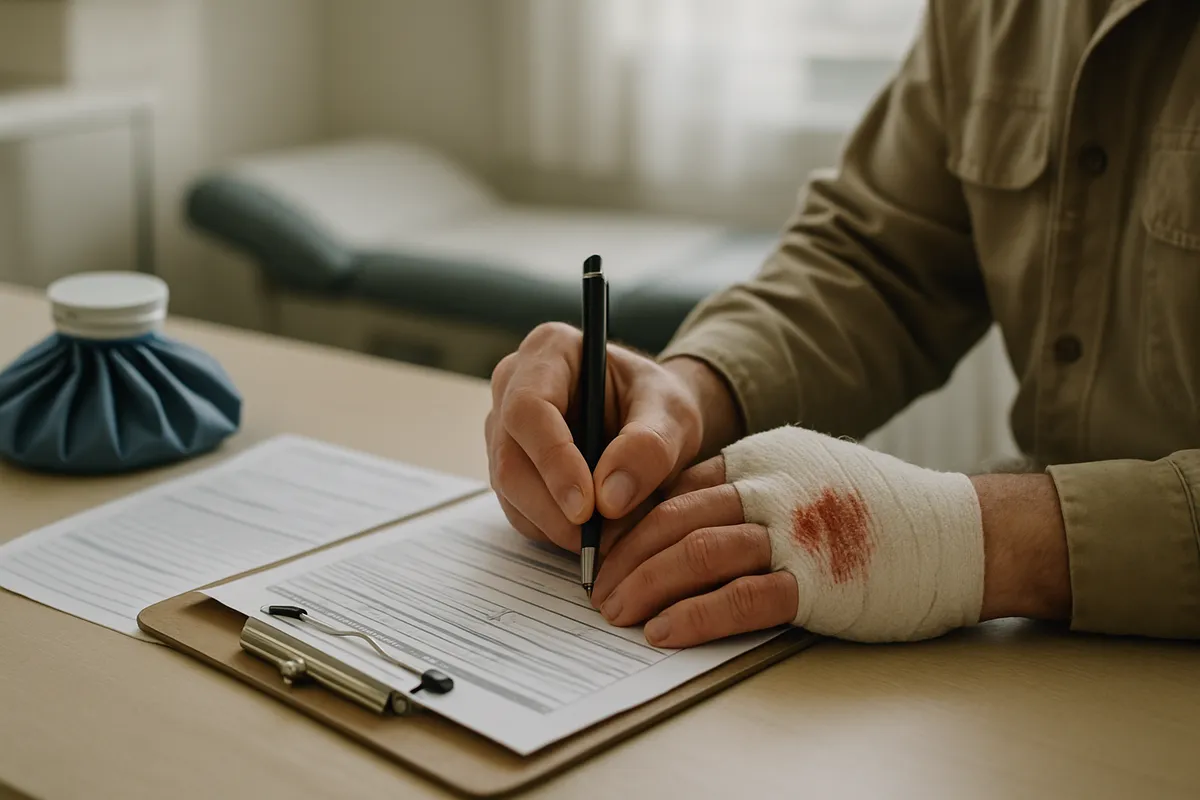
It isn’t only broken bones and bruises. Post-traumatic stress disorder (PTSD) and other psychological injuries after a violent incident can be compensable too, once the work connection is shown. Mental-injury claims simply demand a tighter medical record — diagnosis and treatment notes — than a physical injury does.
So I can’t just sue my employer?
As a rule, no — because comp is your exclusive remedy against the company. New York Workers’ Compensation Law §11 and §29(6) trade the right to sue for guaranteed no-fault benefits: the employer pays premiums and covers you regardless of fault, and in exchange you generally cannot bring a civil suit against that employer for the same injury. That bargain is the whole architecture of the system.
The exceptions are narrow. To pierce exclusivity, you’re essentially looking at an employer who acted with a deliberate intent to harm you. “They ignored safety,” “they knew it was dangerous and did nothing” — ordinary negligence, even gross negligence, does not clear that bar under settled New York law. So coming at this purely as a grievance against the company almost always hits a wall. The money is somewhere else.
Then who do I actually sue? (Third-party liability)
The attacker, and whoever was supposed to keep the place safe. Comp only blocks suits against your employer. A claim against a third party — anyone who isn’t your employer — proceeds alongside your comp case, and that’s where you go after the pain and suffering and the full measure of damages comp never pays.

The usual defendants line up like this. First, the person who assaulted you — an assault is a straightforward intentional tort. Second, the property owner or premises operator — if the location had a history of incidents or sat in a high-crime area and management still skipped reasonable measures like working locks, lighting, or guards, that’s negligent security and premises liability. Third, a security contractor that was hired to protect the site and didn’t. Negligent-security cases live or die on foreseeability — whether the danger was predictable — so prior police reports for the same location and surviving camera footage are everything.
What happens to the comp money I already collected once I win a third-party case?
The comp insurer takes its share out of your recovery first. New York Workers’ Compensation Law §29 gives the comp carrier a lien (and a right of subrogation) on a third-party recovery, up to what it already paid you in medical and wage benefits. The point is to stop a double recovery for the same loss.
So a third-party lawsuit isn’t simply “more money.” How much actually lands in your pocket depends on how the comp lien gets negotiated and reduced. And here’s a trap people fall into: if you settle with a third party without first getting the comp carrier’s consent, you can jeopardize your future comp benefits. I run the comp claim and the third-party suit off the same table from the start, so the lien and the consent step are handled together. One more piece — for a third party to drag your employer back in to share the bill (impleader), New York narrows the door to workers who suffered a “grave injury” (WCL §11), like amputation, blindness, or severe brain damage.
If the company let the violence happen, is there really no consequence for them?
Direct civil damages are blocked, but their safety failures still become your evidence. The federal OSHA General Duty Clause, §5(a)(1), requires employers to furnish a workplace “free from recognized hazards.” When workplace violence is repeated or telegraphed in advance and the employer does nothing, that’s an OSHA complaint and citation exposure.
New York went further. The New York Retail Worker Safety Act requires covered retail employers to adopt a workplace violence prevention policy and train their staff. A violation like that won’t, by itself, let you sue the employer directly — but it’s powerful proof in your third-party case that the danger was foreseeable. The play is to braid all three together: the comp claim, the third-party suit, and the regulatory failures.
Here’s how the moving parts line up in a workplace-violence injury case:
| Track / defendant | Basis | What it gets you |
|---|---|---|
| Workers’ comp claim | NY WCL (no-fault) | Medical care + lost wages (no pain & suffering) |
| Direct suit vs. employer | Generally barred (WCL §11 & §29(6)) | Only the narrow deliberate-harm exception |
| Suit vs. the attacker | Assault / intentional tort | Full damages, including pain & suffering |
| Suit vs. owner / security firm | Negligent security & premises liability | Full damages if foreseeability is shown |
| Resolving the comp lien | WCL §29 | Coordinates double recovery, drives net payout |
| Safety-law violations | OSHA §5(a)(1) / Retail Worker Safety Act | Evidence of foreseeability |
Frequently Asked Questions
Q. Two coworkers got into it and I was hurt — is that covered?
It depends on the work connection. A fight rooted in job duties or assignments can qualify for comp; a purely personal feud is where it gets contested. Document what set off the confrontation.
Q. The attacker ran off and I don’t know who it was — am I out of luck?
No. Comp doesn’t care about the assailant’s identity. And a third-party claim can still proceed against a property owner or security contractor that failed to keep the premises safe.
Q. I didn’t report it to my employer right away — is it too late?
Move quickly. New York generally requires written notice to the employer within 30 days and a comp claim within two years. A negligence suit against a third party usually runs three years, but the evidence vanishes far faster than that.
Q. If I take workers’ comp, am I giving up the lawsuit?
No. The two run together as separate tracks. Just remember the comp carrier’s lien attaches to anything you recover from a third party, so coordinate before you settle.
A workplace-violence case where you only look at the attacker is a case seen at half-strength. In practice these collide with other issues — a denied workers’ comp claim and the appeal, the overlap of comp and a third-party suit you already see in construction-site falls, a property owner’s negligence on the premises, or false imprisonment and wrongful arrest inside stores — so the whole matter has to be seen in one frame.
A workplace assault is a case where the evidence evaporates in days. Use comp to stop the bleeding on medical bills and wages, build a third-party suit against the attacker, the owner, and the security firm for the rest, and clean up the lien so the net recovery holds — that’s how I, Jay Koo, handle New York workplace violence injury cases.