

The short version
- No pain at the scene doesn’t mean no injury. While adrenaline masks the pain, delayed-onset injuries like whiplash, concussion, and herniated discs can take days or weeks to show up.
- New York No-Fault (Insurance Law §5102) pays your medical bills regardless of who caused the crash, but you have to file the No-Fault application (NF-2) within 30 days of the accident. This is the deadline delayed-injury victims miss most.
- Late complications like a pulmonary embolism from a blood clot can be life-threatening. Any new symptom in the days after a crash deserves immediate medical attention, not a wait-and-see.
- A casual “I’m fine” to the insurance adjuster becomes the exact quote they use later to fight your delayed-injury claim.
- To recover for pain and suffering, your injury has to clear New York’s serious injury threshold (§5102(d)) — and with delayed injuries, an unbroken medical record is what proves you got there.
The people who lose out after a New York crash usually aren’t the ones who were hurt the worst. They’re the ones who told the officer “I’m okay,” drove home, and woke up three days later unable to turn their neck. By the time they see a doctor, the insurer has already built a wall: if you were really hurt, why did you wait? In New York, delayed injuries aren’t rare — they’re the norm for soft-tissue and neurological trauma. What sinks a claim isn’t the delay in symptoms. It’s the delay in the record. Here’s why the pain shows up late, and what you have to do — and say — to protect both your health and your No-Fault claim.
Why do you feel fine right after a crash and hurt days later?
Adrenaline and endorphins released at the moment of impact temporarily block pain signals. As that surge fades and inflammation sets in over the first 24 to 72 hours, neck, back, and head symptoms often surface for the first time.
Start with what your body does in a collision. Your sympathetic nervous system floods you with stress hormones built for survival, tightening muscles and suppressing pain so you can react. That heightened state can last hours, sometimes a day or two. During it, a real soft-tissue injury can feel like nothing more than a bad scare. Once the adrenaline clears and swelling builds around the damaged tissue, the pain, stiffness, and tingling arrive.
In practice, the most dangerous window is the few days a victim spends deciding it’s “no big deal” and putting off the doctor. That’s why what you do in the first 48 hours after a New York accident shapes the whole claim. A gap in your medical record hands the insurer an opening to argue you got hurt doing something else in the meantime.
Which delayed injuries should you watch for most?
Whiplash, concussion, herniated discs and spinal stenosis, and blood clots that lead to pulmonary embolism. Neck and back soft-tissue and nerve injuries tend to appear within days; vascular complications come later and some are life-threatening.
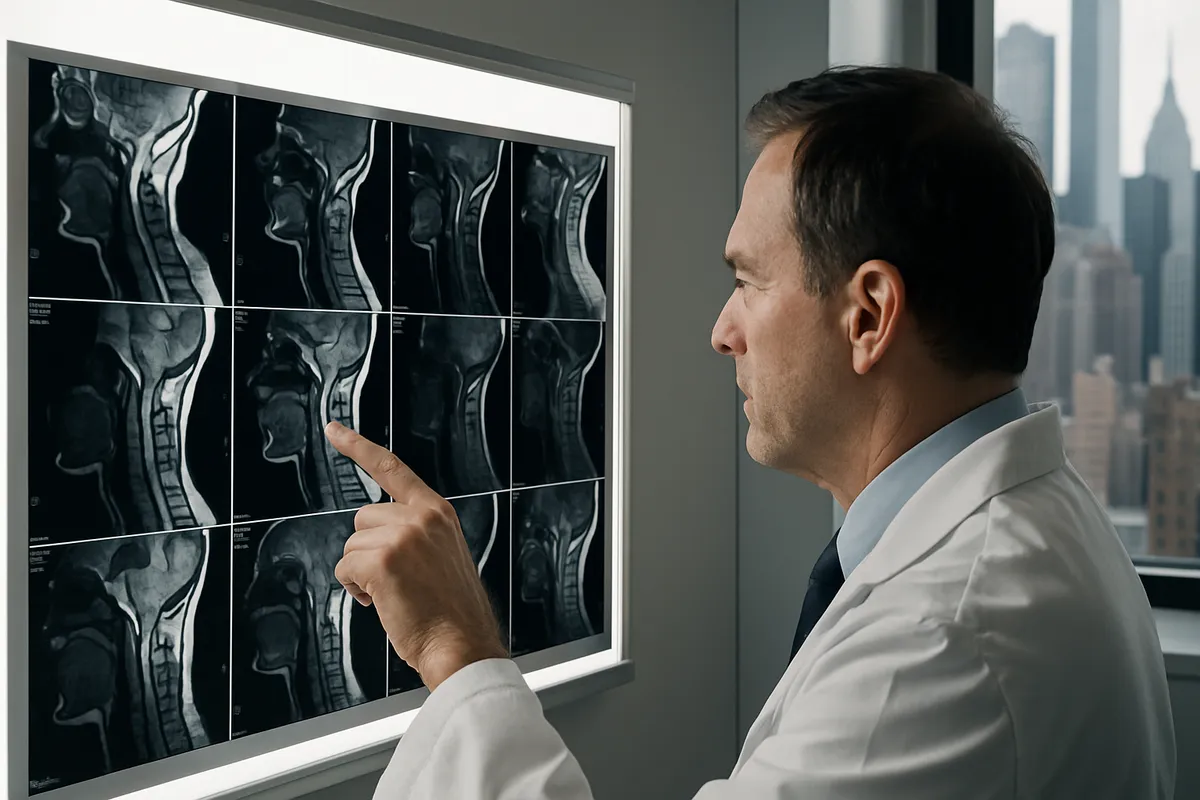
Each of these shows up on its own timeline and carries its own risk. Knowing which symptom points to which injury keeps you from brushing off a new signal from your body after the crash.
| Delayed injury | Common late symptoms | Typical onset |
|---|---|---|
| Whiplash | Neck pain and stiffness, headache, dizziness | Hours to days |
| Concussion / mild TBI | Headache, trouble focusing, mood and sleep changes | Days to weeks |
| Herniated disc / spinal stenosis | Back or neck pain, numbness or radiating pain in limbs | Days to weeks |
| Deep vein thrombosis / pulmonary embolism | Calf swelling and pain, sudden shortness of breath, chest pain | Days to weeks (emergency) |
| Internal injury or bleeding | Abdominal pain, dizziness, spreading bruising | Hours to days |
Pay special attention to sudden shortness of breath, chest pain, or swelling in one leg — these can signal a pulmonary embolism and mean a trip straight to the ER. Complications like these warrant even more caution in crashes where the body is exposed, the way they are on a motorcycle or bike. When a symptom is ambiguous, the safe move is to see a doctor and create a record, not to watch and wait.
How do you get your delayed injuries covered under New York No-Fault?
File the No-Fault application (NF-2) with the insurer within 30 days of the accident. New York No-Fault (Insurance Law §5102) pays medical bills and part of your lost wages without regard to fault, but miss that 30-day window and the carrier can deny the claim absent a good reason.
This deadline is exactly where delayed-injury victims trip. New York No-Fault (Insurance Law §5102) pays first regardless of fault, but only if the claim is open in time. They think, I’m not hurting yet, I’ll deal with it later, the 30 days run out, and then the pain starts. Open the No-Fault claim on the basis of the accident itself, even with no symptoms. With the claim open, treatment for injuries that surface later has somewhere to land.
The clock actually runs on two tracks. The application itself is due in 30 days; individual medical bills are generally due within 45 days of treatment under the No-Fault regulations (11 NYCRR §65). New York No-Fault covers medical expenses, necessary costs, and lost earnings up to the basic economic loss limit, and how that structure applies varies by accident type — something the New York No-Fault insurance system itself lays out in detail. The rule of thumb is simple: your body may look fine, but open the paperwork the day of the crash.
Why does saying “I’m fine” block your delayed-injury claim?
Because that statement, made right after the crash, becomes a record denying you were hurt — and the insurer uses it to sever the link between a later symptom and the accident. “I’m fine” is one of the most effective tools they have to defeat a delayed-injury claim.

The mechanics are straightforward. The adjuster calls in the days after the crash, asks whether you’re injured, and logs your “I’m fine, just shaken up” as a recorded statement. Weeks later, when an MRI shows a herniated disc or a doctor diagnoses a concussion, the carrier plays that recording back: you told us you were fine. Delayed injuries are supposed to appear late — but that one line lets them recast a genuine crash injury as something unrelated that happened afterward.
The defense is clear. Until you’re medically cleared, answer questions about your condition with “I’m still being treated and evaluated” — and never declare yourself healed. That’s the heart of what not to say to an insurance adjuster after a crash. The first thing Jay Koo checks in a delayed-injury case is whether the early statements and medical records line up. The stronger that initial record, the more cleanly a late-appearing symptom connects back to the accident as a single, unbroken line.
To claim pain and suffering, what is New York’s serious injury threshold?
To recover pain and suffering from the at-fault driver — beyond what No-Fault pays — your injury has to meet New York’s serious injury threshold (Insurance Law §5102(d)). Fractures, permanent or significant limitation of a body function, and the so-called 90/180-day rule are the categories that decide whether you clear it.
New York No-Fault comes with a trade-off: you get your medical bills paid regardless of fault, but a lawsuit for pain and suffering is only allowed if your injury rises to the level of “serious.” Delayed injuries are vulnerable right here. A late diagnosis invites the argument that the injury wasn’t that serious to begin with.
That’s why continuity of the record decides these cases. An unbroken treatment timeline — first visit right after the crash, a return when symptoms appear, then imaging like an MRI and a specialist’s findings — is the backbone of proving a serious injury. Add a fault dispute on top and the math gets harder. New York applies pure comparative negligence (CPLR §1411), so your recovery drops by your share of fault, which means you also need to understand how comparative fault plays out in an actual settlement to see the whole picture.
Delayed injury: what should you do right now?
See a doctor immediately and create a record even without symptoms, open your No-Fault claim within 30 days, and manage what you say to the insurer. Those three moves are the backbone of handling a New York crash injury.
Here’s the order that works.
- Get examined now. Even pain-free, see a doctor or your primary care physician the day of the crash or the next day and have it logged as a post-accident evaluation. That first record is the baseline for every claim that follows.
- Act on new symptoms fast. If headaches, numbness, swelling, or shortness of breath appear days later, get re-examined without delay — and treat shortness of breath or chest pain as an ER emergency.
- Open the 30-day No-Fault claim. File the NF-2 right after the crash, regardless of how you feel, to keep the door open.
- Manage your statements. Give the adjuster facts only — “still being treated” — and never declare yourself healed.
- Check the statute of limitations. New York’s personal injury statute of limitations is generally three years from the accident (CPLR §214), but a much shorter, separate deadline applies when the defendant is a city or state entity.
When a moment comes that’s hard to judge on your own, Jay Koo uses the first consultation to check the status of your No-Fault claim, the continuity of your medical record, and whether you can clear the serious injury threshold — resetting the clock you didn’t know was running.
Frequently Asked Questions (FAQ)
Q. I wasn’t in pain right after the crash but I’m hurting now — can I still recover?
Yes. Delayed injuries like whiplash, concussion, and herniated discs are supposed to appear late. What matters is seeing a doctor as soon as symptoms start and using that early record to tie the injury back to the accident.
Q. When do I have to file my No-Fault claim?
File the No-Fault application (NF-2) with the insurer within 30 days of the accident, and submit individual medical bills generally within 45 days of treatment (11 NYCRR §65). Opening the claim right after the crash, even with no symptoms, is the safe move.
Q. What should I tell the adjuster when they ask if I’m hurt?
Until you’re medically cleared, say only that you’re “still being treated and evaluated” — don’t declare yourself fine. An early “I’m fine” can be used later to fight a delayed-injury claim.
Q. Is a late complication like a pulmonary embolism covered as a crash injury?
If it’s causally linked to the accident, yes. But a pulmonary embolism from deep vein thrombosis can be life-threatening, causing sudden shortness of breath and chest pain, so emergency care comes before any talk of compensation.
Q. How long do I have to sue over a New York crash injury?
The personal injury statute of limitations is generally three years from the date of the accident (CPLR §214). A much shorter, separate deadline applies if the defendant is a city or state entity, so even with a delayed injury it’s safest to confirm the clock early with an attorney.
Handling a delayed injury in New York isn’t a fight against pain. It’s a fight against time and the record. While your body takes its time sending the signal, the legal clock and the insurer’s defense are already moving. Knowing what to do and what not to say is often the whole difference — and Jay Koo works to keep your claim open and your record intact before every symptom has surfaced.